Choosing a golf coach in Singapore can feel overwhelming. With so many options, how do you find the one who can truly elevate your game? It’s not just about finding an instructor; it’s about finding a long-term partner for your golfing journey. Wasting time and money on the wrong fit is a common fear, but it doesn’t have to be your reality.
This guide provides a clear framework for choosing the right golf coach in Singapore by evaluating qualifications, teaching styles, and technology to truly elevate your game. We’ll move beyond simple price comparisons to help you assess true value, ensuring your investment leads to tangible results and a deeper enjoyment of the sport.
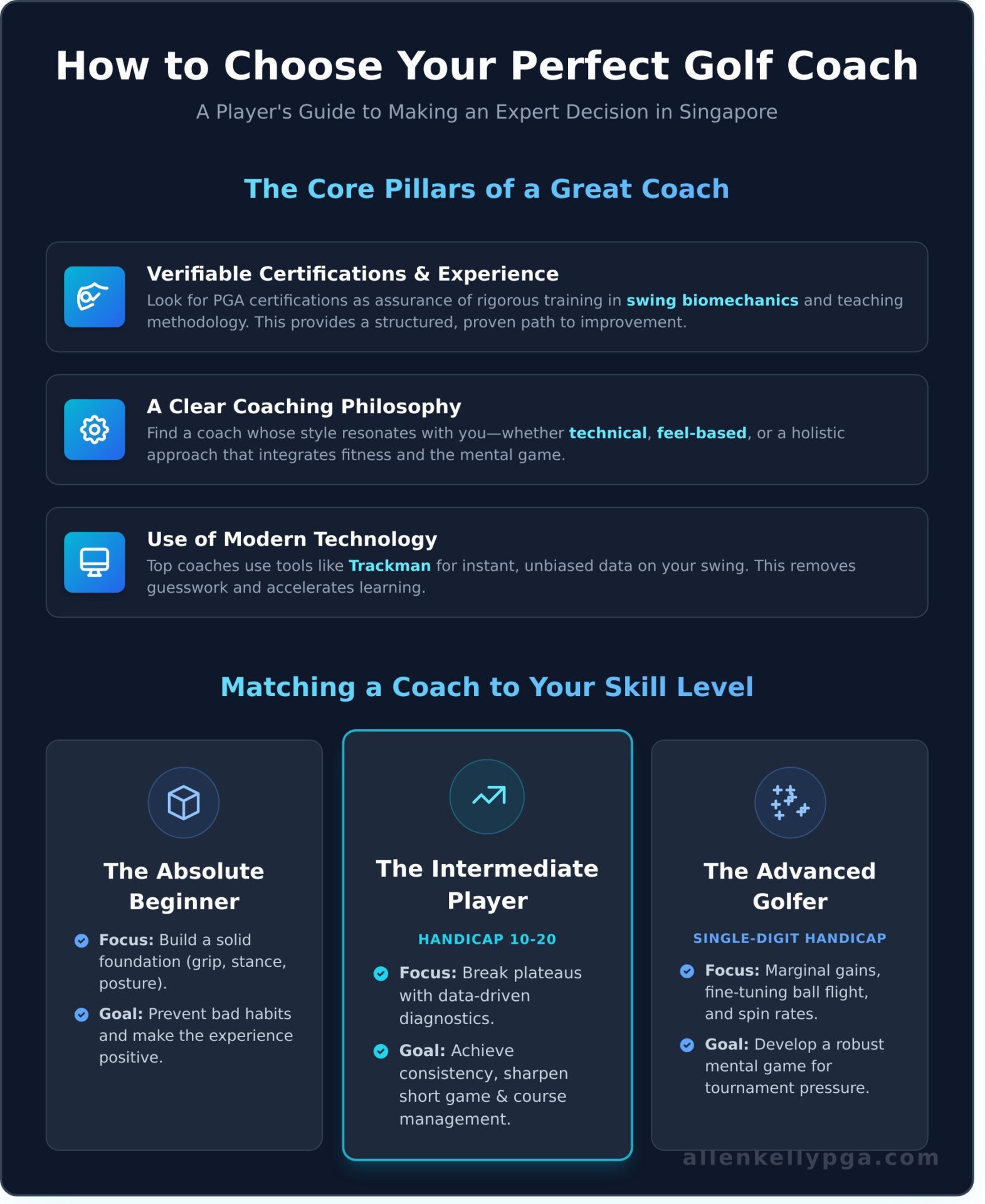
What to Look For: The Key Pillars of a Great Golf Coach
Before you book your first lesson, it’s crucial to understand what separates an average instructor from a great coach. A great coach doesn’t just fix your slice; they build a comprehensive plan tailored to you. Think of this as a checklist for making a confident and informed decision.
1. Verifiable Certifications and Experience
Anyone can call themselves a golf instructor, but a certified professional has proven their expertise through rigorous training and testing.
- PGA Certification: This is the gold standard. A PGA-certified professional has undergone extensive education in everything from swing mechanics and teaching methodology to club fitting and ethics. It’s a guarantee of a high level of knowledge and professionalism.
- Certified vs. Uncertified: A certified pro offers a structured, proven approach, while an uncertified instructor may rely on personal anecdotes. For consistent, long-term improvement, certification is a non-negotiable.
- Local Experience: A coach with years of experience in Singapore understands the local climate, course conditions, and the specific challenges golfers face here. This deep experience allows them to adapt their methods to a wide variety of student needs and learning styles.
2. A Clear Coaching Philosophy
Every great coach has a core philosophy that guides their teaching. The key is finding one that resonates with your personality and how you learn best.
- Different Approaches: Some coaches are highly technical, using data to deconstruct every element of the swing. Others are more "feel-based," helping you develop an intuitive understanding of your motion. A holistic coach integrates fitness, mental strategy, and on-course management.
- Clarity is Key: A great coach should be able to clearly articulate their method and explain why they are suggesting a specific change.
- Beyond the Swing: Look for coaches who understand that golf is more than just mechanics. The best programs often incorporate aspects of the mental game and physical conditioning to build a more complete and resilient player.
3. Use of Modern Technology
In today’s game, data is a powerful accelerator for improvement. Top-tier coaches leverage technology to provide feedback that is impossible to see with the naked eye.
- Launch Monitors: Tools like Trackman provide instant, unbiased feedback on dozens of data points, including club speed, ball flight, spin rate, and attack angle. This data removes guesswork and allows for precise adjustments.
- Video Analysis: Seeing your own swing is a game-changer. Video analysis allows you and your coach to slow down and review your movements frame by frame, helping you understand the connection between what you feel and what is actually happening.
- Effective Practice: Technology makes practice more efficient and measurable. Instead of just hitting balls, you can work on specific metrics and see your progress in real-time.
Matching a Coach to Your Skill Level and Goals
The "best" golf coach is relative; the right coach for a complete beginner is different from the one needed by a competitive tournament player. Being honest about your current ability and future ambitions is the first step to finding the perfect match.
For the Absolute Beginner
The primary goal for a new golfer is to build a solid foundation while having fun. A good beginner coach prevents bad habits from forming before they start.
- What to Look For: Patience and an ability to explain the fundamentals—grip, stance, posture, and basic swing motion—in a simple, easy-to-understand way.
- Focus: The initial lessons should be about making consistent contact, understanding the basic rules and etiquette, and enjoying the process of learning.
For the Intermediate Player (Plateauing)
You can hit the ball consistently, but your handicap hasn’t budged in months. This is where a skilled coach becomes essential for breaking through performance plateaus.
- What to Look For: A coach who is an expert diagnostician. They should use technology and their trained eye to pinpoint the specific flaws in your swing that are holding you back.
- Focus: The emphasis shifts to improving consistency, mastering the short game, and developing better course management. Data from a launch monitor becomes crucial for identifying and fixing underlying issues.
- Break through your plateau with expert analysis.
For the Advanced/Competitive Golfer
For single-digit handicappers and tournament players, improvement is about fine-tuning and gaining a competitive edge.
- What to Look For: A coach with a proven track record of training high-level players. This relationship is often a long-term strategic partnership.
- Focus: The work becomes highly detailed, focusing on things like controlling ball flight, managing spin rates, and advanced shot-shaping. Mental game coaching and tournament preparation are key components.
The Learning Environment: Range vs. Indoor vs. On-Course
Where you learn can be just as important as how you learn. Singapore’s climate makes having different options a huge advantage. A top-tier coach will often use a blend of environments to develop all aspects of your game.
The Driving Range: Real Ball Flight
This is the classic setting for a golf lesson. It’s the perfect place to work on swing mechanics while seeing the results in real-time.
- Benefits: The immediate feedback of seeing your actual ball flight and how your shots interact with the turf is invaluable for understanding cause and effect.
- Ideal For: Working on full-swing fundamentals and understanding shot shapes. A top-tier facility like Orchid Country Club provides the perfect environment for this.
Indoor Studios: Data-Driven Precision
An indoor coaching studio offers a controlled environment, free from weather and other distractions, making it perfect for focused, technical work.
- Benefits: Simulators like Trackman provide precise club and ball data that is essential for deep analysis. It allows for year-round practice and is incredibly effective for gapping your clubs and understanding your exact distances.
- Ideal For: Technical swing changes, equipment fitting, and structured practice sessions.
On-Course Lessons: Real-World Strategy
Great swings on the range don’t always translate to low scores on the course. On-course lessons bridge that gap.
- Benefits: This is where you learn how to play the game, not just how to swing. A coach will guide you on course management, shot selection, and developing a pre-shot routine under real playing conditions.
- Ideal For: Learning to handle uneven lies, wind, and the pressure of a real round. This is where you learn how to score.
Understanding Golf Lesson Packages and Pricing in Singapore
Professional coaching is an investment in your skill and enjoyment of the game. Understanding the costs and structures helps you find a program that fits your budget and commitment level.
Individual Lessons vs. Packages
- Single Lessons: A great option for a trial lesson to assess compatibility with a coach or for a quick tune-up on a specific issue.
- Packages: A package of 5 or 10 lessons typically offers better value per session and signifies a commitment to a structured improvement plan. This allows a coach to build a progressive curriculum for you. Always ask if packages have an expiration date.
What to Expect in Terms of Cost
A private, one-on-one golf lesson in Singapore with a certified professional generally ranges from S$150 to S$250+ per hour. The price is influenced by the coach’s experience and certifications, the location of the facility, and the technology used during the session. Remember to focus on value over the lowest price; a great coach accelerates your improvement, saving you time, frustration, and money in the long run.
Intensive and Group Programs
- Intensive Programs: Multi-day programs are designed for rapid transformation and are perfect for golfers looking for an immersive experience.
- Group Lessons: These can be a more social and affordable way to learn the basics, especially for beginners or corporate groups.
Your Action Plan: Vetting and Choosing Your Coach
You now have the criteria to make an informed decision. The final step is to put it into action and engage with potential coaches.
Step 1: Shortlist Coaches Based on Research
- Review their website to understand their coaching philosophy, read testimonials, and verify their credentials (e.g., PGA certification).
- Check their social media for coaching content, student success stories, and their general communication style.
- Prioritize coaches who are transparent about their methods and whose coaching locations are convenient for you.
Step 2: The Initial Consultation or Trial Lesson
This is the single best way to determine if a coach is the right fit for you.
- Pay attention to their communication style. Are they clear, patient, and encouraging?
- Do they listen carefully to your goals, frustrations, and concerns?
- A trial lesson is your opportunity to see their expertise in action and assess your personal chemistry.
Step 3: Key Questions to Ask a Potential Coach
- How do you measure and track a student’s progress over time?
- Based on my goals, what would your initial approach be?
- What technology, like Trackman or video, do you use during lessons?
- Schedule a consultation to discuss your game with Allen Kelly.
Frequently Asked Questions
How much do golf lessons typically cost in Singapore?
A private one-hour lesson with a certified golf coach in Singapore typically costs between S$150 and S$250. Prices can vary based on the coach’s experience, the facility, and the technology included.
Do I need my own set of golf clubs for my first lesson?
No, most coaches and facilities can provide rental clubs for your initial lessons. It’s often better to wait for your coach’s recommendation on equipment after they have assessed your swing.
How many lessons does it take to see a real improvement in my game?
For beginners, noticeable improvement in fundamentals can happen within 5-10 lessons. For intermediate players, breaking a plateau may take a similar commitment. Consistency is key; real, lasting improvement comes from structured lessons combined with regular practice.
What is the difference between a PGA-certified coach and a regular instructor?
A PGA-certified coach has completed a rigorous, multi-year education and testing program covering all aspects of the game, teaching, and player development. It represents a globally recognized standard of excellence and professionalism that an uncertified instructor may not have.
Is an indoor golf simulator lesson as effective as an outdoor one?
They serve different but complementary purposes. Indoor lessons are superior for technical analysis and data-driven feedback in a controlled environment. Outdoor lessons are essential for learning ball flight control, turf interaction, and on-course strategy. A great coach utilizes both.
Can a golf coach help with the mental side of the game, not just the swing?
Absolutely. An experienced coach helps with course management, pre-shot routines, and strategies for handling pressure, which are all critical components of the mental game.
Ready to stop guessing and start improving with a structured, proven plan? A dedicated coach can provide the expert guidance and personalized feedback you need to finally reach your potential.
Ready to elevate your game? Book your first lesson with Allen Kelly today!
- Over 20 years of coaching experience in Singapore.
- Fully PGA-certified professional.
- Utilizes state-of-the-art Trackman technology.